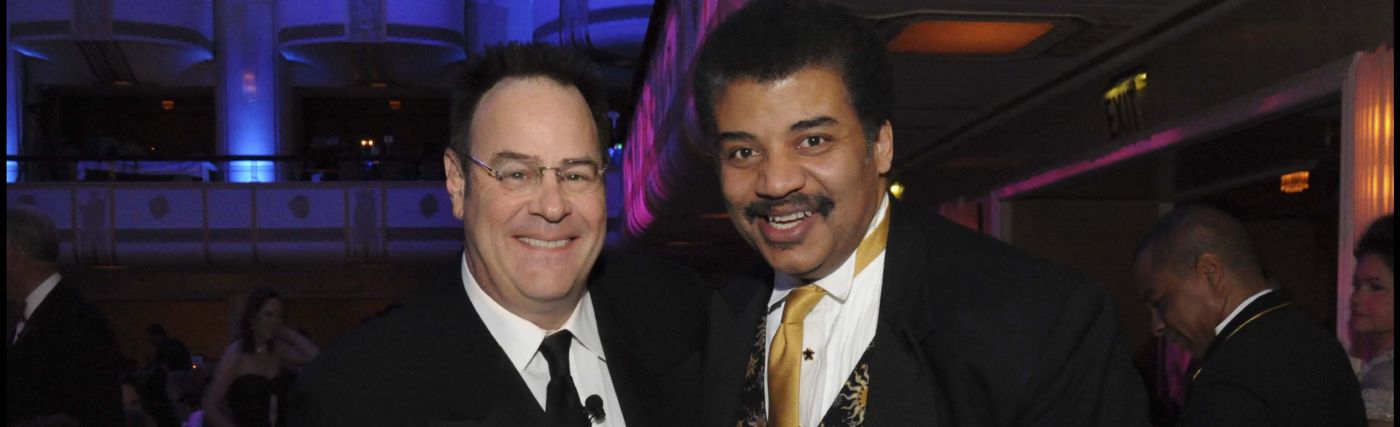
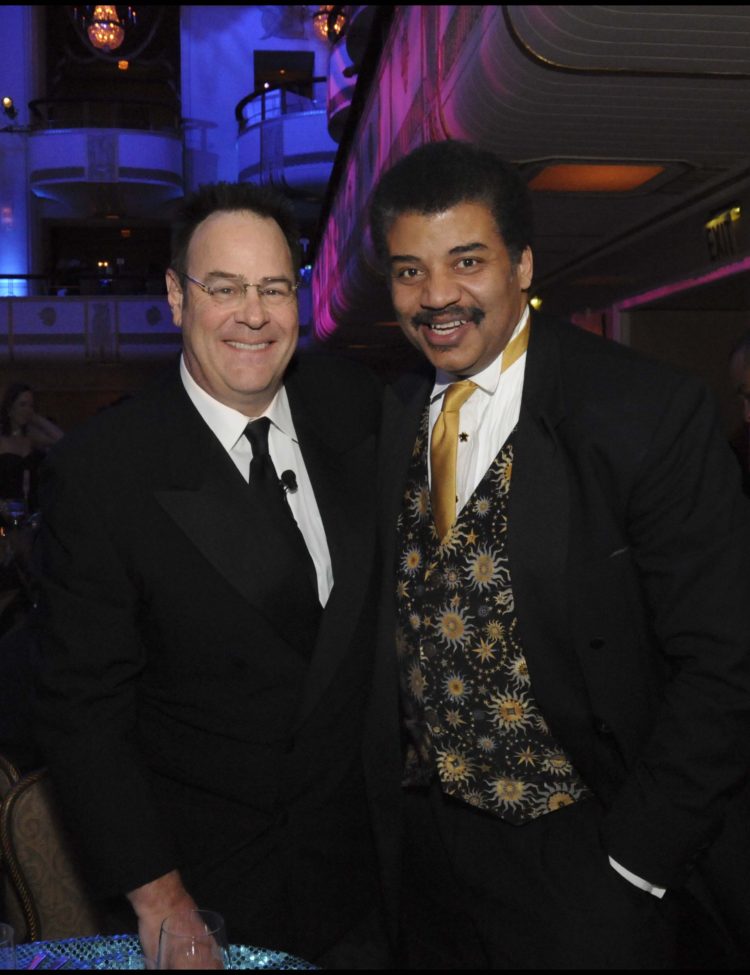
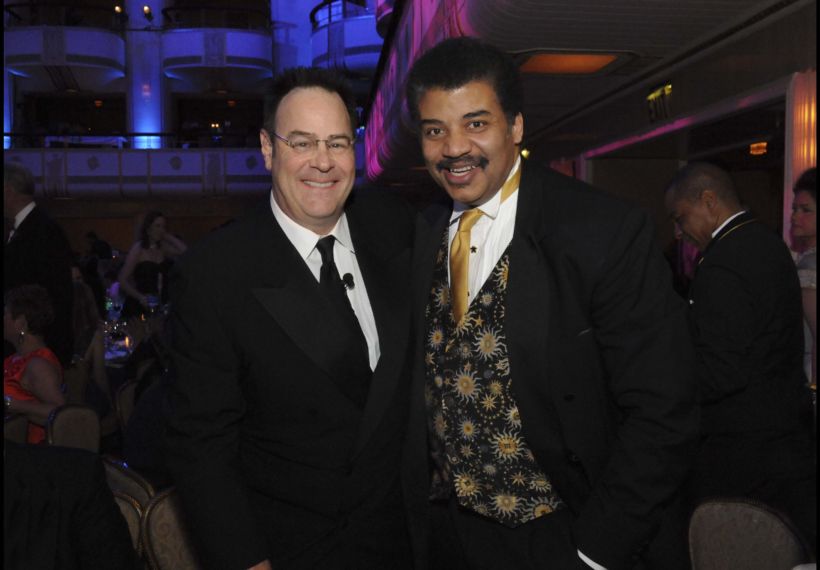
Is there a science of humor? Find out when Neil deGrasse Tyson sits down with Dan Aykroyd, founding Saturday Night Live cast member and star of classics like Ghostbusters and The Blues Brothers. Dan deconstructs comedic forms, from improv and sketch comedy to sitcoms and movies, touching upon the universality of humor. (He also hints about the possibility of a Trading Places sequel!) But it’s not all about the laughs: Dan and Neil also discuss the molecular composition of vodka, crystal skulls, the Earth’s molten iron core, and all of the ingredients that coalesced to form America’s homegrown music, the Blues. Comic co-host Chuck Nice volunteers his own take on comedy, including how science and comedy rely on experimentation, what makes a great joke, and an uncanny impersonation of Bill Cosby. Plus, Astrophysicist Charles Liu shares a U. of Michigan study on the impact of flatulence on comedy.
Transcript
DOWNLOAD SRT
Welcome to StarTalk, your place in the universe where science and pop culture collide. StarTalk begins right now. Welcome to StarTalk Radio. I'm your host, Neil deGrasse Tyson. And I'm here with my co-host, Chuck Nice. Hey, Neil. Chuck, you've...
Welcome to StarTalk, your place in the universe where science and pop culture collide.
StarTalk begins right now.
Welcome to StarTalk Radio.
I'm your host, Neil deGrasse Tyson.
And I'm here with my co-host, Chuck Nice.
Hey, Neil.
Chuck, you've been here like a zillion times in like the last month.
You know?
I'm just saying.
I'm not complaining, are you?
And whenever we have like an interesting subject where we need like a man about town who knows everything about everything, I bring in my friend and colleague, astrophysicist, Charles Liu.
Yes.
It is a pleasure, Neil.
Hey, Chuck, good to see you.
I'm well.
So, what we've got here for this show is it's a conversation with Dan Aykroyd.
Oh, yes.
The Dan Aykroyd, there's only one, Dan Aykroyd.
Dan Aykroyd, the Dan Aykroyd.
The Blues brother.
Blues brother, a Blues brother, a founding member of the Not Ready for Primetime Players.
That's right.
Saturday Night Live, been in all kinds of movies.
So, he came to my office, visited me, I whipped out the mic and I said, I'm not letting this go by.
We're gonna talk and I'll go put it on StarTalk.
So, just to remind you, what are some of his other movies, you remember?
Oh, let's see, how about Spies Like Us?
Yeah, it just goes on.
How about My Stepmother is an Alien?
And Who's Gonna Forget Trading Places?
Trading Places.
And Mortimer?
Feeling good.
Feeling good Mortimer.
And Driving Miss Daisy, for which he was nominated for an Academy Award.
He was the son, he was the son in Driving Miss Daisy.
Hired Morgan Freeman.
So, let's go to my first clip in my interview with him.
Because in that clip, I just talked about the anatomy of a Saturday Night Live sketch, right?
Because it hadn't quite, you know, before then, you had Vaudeville and things.
Well, what is the anatomy of that?
And how do they make it work?
Let's see.
Can you say that there's a science of sketch comedy?
Or is it from your gut?
I think if you want to look at structure in comedy, where you're going to find structure and science is more in the sitcom realm, because it's set up delivery punch, set up delivery punch, it's formulaic.
In sketch comedy, it's less formulaic, it's more absurdist.
You're never really sure of an ending, so you're not so conscious of bringing the scene to a peak and then coming out of an anti-climax and then finishing it on a climax.
It's more where the writing and collaboration takes you, so it's less scientific and less formulaic, really.
Sketch comedy is much more ephemeral.
Yeah, I also noticed that so much of it is in the setup, the humor in just the construct.
Is that fair to say?
Yeah, the concept of where you're starting out from would hopefully lead you in an organic sense.
I think sketch comedy is much more organic than, say, structured film comedy or sitcoms.
The sketch comedy, the improv, is the purest.
And the purest form is, of course, Second City.
Your roots.
Yes.
Second City is Mercury rolling across the table and splitting up into little balls.
And sitcom or film is more of a structured molecular picture where you're actually designing and confining things.
There is no confinement in improv and there's no confinement in sketch comedy.
Sometimes we do scenes at SNL where there really was no ending.
We could just keep going and going and, you know, we decide, well, we got to end it because at three minutes, they'd hit the applause button to end the thing.
So it's much more open and free form and I would say organic.
So how many comedians get to actually make that transition?
Because it's not obvious that the improv is going to sit down and write a whole movie.
Again, you know, when you're doing a structured television and film, you've got to have some discipline there and that means actually structuring and confining it.
The only place where it's really free is in the improv stage at Second City and that's where you can really, really soar.
I was happy to be a part of that and I'm happy to join people like Betty Thomas, Mike Nichols, Elaine May, Harold Ramis, who were hyphenates.
They wrote, they performed and then went on to take their skills and do great movies like Animal House and Groundhog Day and projects like that, where he took the best of the improvisational world and then confined it and structured it in the world of film so that there was a beginning, middle and end.
Is there any coincidence that one of the most popular children's programs of all time, Sesame Street, is basically structured like SNL?
It's sketches.
It's sketches, yeah.
There's no plot, there's no, it's just, let's have fun for three minutes.
Yeah, and don't demand too much, you know, you've got children there watching.
You don't demand too much of them and you more try to entertain them, purely entertain them, and that's what the value of Sesame Street is, edutainment.
But the value of SNL is pure entertainment, where you know, you're not really looking to sell a lesson, like a movie or a sitcom, for instance, or any hour TV show.
Those are the three major forms, an hour drama, a half hour sitcom, or a movie.
There's always some kind of moral lesson that they're trying to put across to you, or sort of in the end, you have to come out with some kind of view that, oh, these people are all right, or they weren't, or you have to make a moral judgment.
With sketch comedy, there may be lessons in Sesame Street that were none in Saturday Night Live.
Well, I got some important lessons from Saturday Night Live as a kid.
Yeah.
Charles Liu, oh, that was your Sesame Street, is that right?
I am who I am today because of that show.
What can I say?
Not bad.
So Chuck, you're the professional in the room here.
So would you agree there's a science to comedy?
Absolutely.
As he was saying?
Without a doubt.
He was just deconstructing it all.
He really did.
I mean, the one thing I will take issue with is the fact that he said-
Wait, wait, you're taking issue with Dan Aykroyd?
Listen, sorry, Dan-
How many movies you've been in?
Oh, three, but that's okay.
No, so go on.
But the fact is that he said that sketch is the purest, and I'm sorry, but stand up is the purest.
Stand up is the purest form of comedy that there is.
I'm sorry, Dan Aykroyd, because there is nothing there but you and a microphone, and you have to utilize that to create comedy.
That's all you have.
I'm not talking about prop comics.
Because they exist too.
I know they exist.
The satchel full, and who's the one with the puppet?
The ventriloquist.
Ventriloquist, yeah.
Listen.
You got a ventriloquist dummy?
I do.
Actually, no.
My wife has a ventriloquist dummy.
I forget who I am sometimes.
But the truth is that, no, stand up is the purest form of comedy because all you have is you on a stage with your words.
And the science that he was talking about is, there's a science to a joke.
And one of the things that you'll find, and it's a mistake that many younger comics make, the longer the setup, the harder it is for you to get the payoff.
So the shorter the setup, the bigger the payoff.
That is if it's funny.
And in other words, you can fall farther if you have a big setup and it doesn't hit.
Absolutely, because you think of it as climbing a ladder and you got to get to the payoff.
And ain't nothing on the other side.
I'm gonna be angry if I climb the ladder.
Well, I can tell you something about the science of humor, not comedy, but humor.
What's that?
Well, a few years ago, a University of Michigan study, a scientist did some things with various malodorous chemicals and test subjects and proved that farts make everything funnier.
Really?
What, farts or the sound of a fart?
Yeah, I was going to say, because the actual smell of a fart actually doesn't make anything funnier.
That's just what the science says, folks.
I think this guy was a freak who just liked, you know, malodiferous scents.
What can I say?
But it is true that SNL has avoided flatulent humor.
From what I've seen.
Good, because, you know.
So you don't have to go there even if it does work.
It means you have to be clever to avoid it to still get someone to laugh.
Makes sense to me.
Well, when we come back on our next segment of StarTalk, more of my conversation with Dan Aykroyd.
In studio, check Nice, Charles Liu.
We're back, StarTalk Radio, featuring my in-office interview with Dan Aykroyd.
And so, Chuck, I got you here with me because you're a professional comedian.
Yes.
I laugh at everything the man does.
Dan Aykroyd or me?
So, as I said, he's one of the original cast members of Saturday Night Live with Chevy Chase and Gilda Radner and the Bunch.
And he went on to star in movies like The Blues Brothers.
It's one of those movies, if you're channel surfing, you stop.
You have to.
It doesn't matter what football game is on, it doesn't matter, you stop.
There are laws of physics and there are laws of television watching.
Coming across The Blues Brothers and stopping is a law of television watching.
It's a law.
And not only that, Trading Places is up there with me as well.
You know, you can't argue with Eddie Murphy.
Once you had a man with no legs, you never go back.
I love that.
Those men tried to have sex with me.
Oh, I love it.
I freaking love that movie.
I feel like every member of Congress should see that movie at least once before they run for office, don't you think?
Absolutely.
Well, I think members of Congress need to do much more than that.
So we've got a clip.
So Dan Aykroyd visited me in my office at the Hayden Planetarium and pulled out the mic and asked them everything I could come up with about comedy, about the science of comedy.
And in this next clip, I would just talk about the, so the timelessness of humor, just to find out, is there such a thing and what can you do with it and what can you do about it?
Let's find out.
I always operated on the premise that if I could make myself laugh, then that's one human being that could laugh.
And anytime, you know, being a thousand, 10,000 years ago or now or 20,000 years in the future, one human being laughs, maybe you can get five to laugh.
And if five laugh, maybe 15 and maybe 50 and maybe 500 and maybe 5,000.
So I always just trusted my...
That's a lesson in powers of 10.
Yeah, I just...
Look, everybody has a sense of humor.
Everybody, as so much so that the federal government of the United States has had to put posters in airports saying, do not joke about knives or guns or bombs.
We know you, human, have a propensity to humor.
We know you like to joke.
Well, this is one thing you cannot joke about is a bomb or we will pull you aside to talk about.
There's a sort of a recognition right there, a federal recognition of the universality of humor.
So, if I can be like fanboy here and comment on a scene in Trading Places that my wife noticed after the party, at the party in the townhouse, okay, that Eddie Murphy hosts, what's his character's name, William...
Billy Ray.
Billy Ray, okay.
After the party, and he says, get the F out, okay, the very next scene is the butler is holding all the jackets because it's the winter, it's Christmas time.
And one by one, as they exit, they pull the top jacket off of the pile.
So everyone exited in jacket order.
The film was written by Weingrad and Harris.
To my knowledge, they have never written another movie that's been made or that's been a hit.
And they wrote it on the fax machine.
One of them lived in LA and one of them lived in Michigan.
And they basically wrote one of the greatest American comedies without seeing each other.
This is my understanding.
I had nothing to do with the writing of the film at all.
I did have something to do with the title.
I forget what they, it wasn't called Trading Places originally, but Mike Eisner and I were sitting in a car in Manhattan trying to come up with a title for this movie and we're going back and forth and I was saying The Trade and he said Trading Places and I said, hey, that's why you sit where you are and why you sit where I am.
Everybody liked it and it's clean and simple.
And Eddie Murphy, of course, great young talent at that time with his vibrancy and intelligence.
The second movie.
Instincts coming off SNL was just superb in it.
There has been talk of a sequel, which I would love to pursue because if you look at where finances are in the world today, all these mechanizations and paragrenations of derivative financing that goes on.
Science of trading.
Yeah, and the bogus science of trading and all the perfidy that goes on, the malfeasance and misfeasance, you could really, really do a great expose of financial perfidy through the trading places filter.
However, we have to interest Eddie in that and Paramount Pictures.
Yeah, yeah.
I'm interested.
And of course, we all remember the scene in Coming to America where you've got the Duke brothers as homeless people.
Oh, yeah, yeah, yeah.
On the sidewalk.
Well, that's Landis, John Landis, the brilliant director who directed both films.
So, I like what he said.
He said he wants, he's got to be able to laugh at the joke.
Otherwise, why would he believe anyone else would?
But that presupposes that he's got some representative sort of laugh genes for what everybody would find funny.
You're absolutely right.
I've seen comics who say jokes and nobody laughs.
So clearly, they thought somebody was going to laugh.
And that's exactly how it works.
And this is why you need an audience.
This is why no one writes a joke and then gives it to somebody and says, this is a funny joke, man.
Just don't do this joke because it's funny.
You need to test the joke out.
There is a certain kinship to science and comedy in experimentation.
Scientists find out results through experiments.
If it don't work, you change the parameters.
And you just described how comedy works on a very base level.
That's exactly all it is.
You go out, man, I thought that was funny.
Damn.
You don't go, what's wrong with these people?
That's funny.
These people don't know jack crap.
No.
They don't know from funny.
They don't know from, no.
The results were not what you were looking for as the person conducting the experiment.
And so what you do is you go back and you change the variables so that you can actually get the results that you desire, which is laughter.
Because in science, they're delusional scientists who keep trying to think that their experiment is going to work.
Yes.
We call them alcoholics.
Well, we have kinder names for them too, Chuck.
But really Chuck, my question is about timeless humor.
Is there really such a thing or is all humor all about timing?
It's both.
Great question.
It is a great question, and it is both.
There is timeless humor, okay, because there are certain mechanisms of humor that we get.
Now some of them are tied to culture, okay?
For instance, it's been deemed that the best joke in the world ever written is, Henny Youngman, take my wife, please.
It works all the time because he told-
It worked before the Women's Lib Movement, okay?
But he told a story.
He told an entire story in four words, okay?
Take my wife, please.
You know everything you need to know about that marriage, and that's why it's funny.
So there is a timelessness, but timing is everything.
Without the right timing, you can't get the funny.
That's all there is to it.
Can you judge in the present whether something will be funny decades from now?
If it-
For example-
If you look at, I've looked at the IM, somebody makes this list of IMF, the film people, they've got some abbreviation, and they make the funniest films of all time.
And Some Like It Hot is on that list perennially, okay?
With Marilyn Monroe.
With Marilyn Monroe and the two guys, Jack, who are they?
It's Jack Lemmon.
Jack Lemmon, thank you.
And go ahead.
Marilyn Monroe, Jack Lemmon, that's the main characters.
So, and Tony Curtis, of course.
Yeah.
So, that's always put back at the list no matter who's making the list.
Now, these aren't just people old enough to remember it, they're people who've seen it afresh.
So, well, the reason is because if you are dealing with anything that is human, human nature is timeless comedy.
Why do you think comedians who talk about their families and their children, Bill Cosby, one of the most beloved comics of all time.
Who never said a cuss word in his life.
Never said a cuss word in his life.
Didn't have to because he's using subject matter that we all relate to.
You know, it's, you know, my kids, you see, my kids.
He gave us the chocolate.
Like you get the whole thing.
You get, you feel it all.
Feel it.
You feel it.
And anybody who's been a child, has a child, a brother or sister, an uncle, you get that.
And so human nature makes for timeless comedy.
One of my favorite lines of his, we talked about who's the stupidest person in his house, is the father.
Because he don't know where anything is.
You ask him.
He don't know where he had, he can't cook.
He don't know.
Right.
It goes down the list.
It's down the list as to, and believe it or not, he gave rise to the oafish dad, which has become a sitcom stable.
Where the dad is a complete and total oaf.
Well that came out of Bill Cosby going, you know, I don't know anything because I can't find my socks.
Charles, how long is Big Bang Theory going to be funny?
Well I don't think it's funny anymore.
Okay, end of that?
Sorry.
No, no, no, no, no.
In Big Bang Theory, they make something funny even if you don't know the science behind the humor.
It's still funny to see the characters interact.
For that, I am willing to give it that, yes.
But it's a little long in the tooth, don't you think?
It's that whole timing, timeless.
Except that it's number one sitcom on television.
I don't know how long a tooth you're going to describe it if that's what you're going to say it is.
Can't argue with that.
Don't hate.
Stop hating.
When we come back more of my interview with Dan Aykroyd, StarTalk on the Science of Humor.
We're back, StarTalk Radio.
I'm Neil deGrasse Tyson, your personal astrophysicist.
Today, we're featuring my in-office interview with Dan Aykroyd.
And I got in-studio, Chuck Nice and Charles Liu, sometimes known as Chuck Liu.
I got two Chucks in the audience, two with me.
Two-buck Chuck.
Two-Chuck-butt.
Charles Liu has worked a little more than two bucks.
Before we went to break, Charles, I just wanted to get your reactions on The Big Bang Theory, which is the number one sitcom on television.
So it caricatures geeky scientists, basically.
So I wanna ask you, what do you think about jokes that require that the whole, Chuck spoke earlier about the setup.
And if you have a big setup, you gotta have a big payoff, otherwise you'll piss people off.
So there's a lot of humor in science that I think is untapped, but then you gotta prep people for it so that they'd find out why it's funny.
Yeah, it's a matter of hitting close enough to home that you're sort of violating some safe zone.
So it's like funny, it makes you laugh, but at the same time, you're not going too far.
Charles, what's your scientific safe zone?
Well, there was an episode of The Big Bang Theory where Stan Lee was featured in it, the comic book.
The great comic book illustrator.
Now it turns out that I collected comic books for a large portion of my childhood.
And then your parents threw them out when you went to college.
No, I have them all in my office.
So you're worth a zillion dollars, right?
Most of the stuff isn't worth the paper it's printed on anymore, but yes, there are a few.
Nevertheless, I just remember watching that episode or toward the end of that episode and saying, oh, okay.
But for some reason, it didn't get through my safe zone, didn't get through my comfort zone.
I wasn't able to like say, hey, wow, that was something unusual and made me laugh.
Okay, I laugh every time.
So it's something wrong with you, I think.
I think so.
See, this is completely unrelated, but I have a scientific safe word and it's Higgs boson.
And that stops the beating when it gets a little out of hand.
No, it sounds like the punchline of a joke.
He thought he was a Higgs boson.
Well, Dan Aykroyd is not only humor, he has a huge interest in the blues, as do I, except mine is more just I'll listen to stuff I like.
And he's into it.
And it wasn't just a passing interest with the blues brothers as a blues brother.
So let's just find out what he, I just think about Aykroyd in blues, say what he says.
I love the blues.
And if it comes on on the radio, now you can just go to a whole blues station on Sirius XM, of course.
But in the old days, if there was a blues song that came on the radio, I'd have to pull over to the side of the road and just stop.
Drinking the motion.
My boot hits the accelerator when I hear a blues tune.
If you look at what America's given the world, you can look at science and you can look at culture and art and books and movies.
I think something that really connects to everybody is the roots of rock and roll and the roots of all music today, and that is blues music deriving directly from the slave ships coming over to the Southern Delta in the United States, the field haulers onto the front porches, harmonicas, cigar box, banjos.
Yeah, and the instrumentality of it, the wash tub, and then into church where the organ was put into it, and then back out to the juke joints where now the piano and the organ join with drums, and then the Spanish invented the electric pickup for the guitar.
So you had all of a sudden now blues players plugging in, you know, the migration of black labor up through Memphis and into Chicago, and then finally sitting down in chess studios where you had it all coalesced together with Muddy Waters and the things he was producing where you had the Hammond B3 organ, the electric pickup, the electric harmonica, all of the things from the juke joints and from the fields coming in and being plugged in.
It's an American story.
And it's an American story that's went out to the world that produced British blues, Led Zeppelin, the animals, the Beatles, the Stones, everything that's come out of Britain, came out of that Chicago melting pot, that stew of blues music, and it is distinctly American.
There are Norwegians who can play the blues, and I've jammed with them.
There are Japanese people who can play the blues.
Norway and the blues, just those two words, I've never seen them in the same sentence.
There's a guy named Anders Osborn.
He's a Swedish-born player.
He lives in New Orleans, Louisiana.
He is a great player.
Anna Popovich is a Croatian player, and boy, can she play.
But you see, those countries where they come from, they did not originate blues music.
It happened here, and it spread to the world, and it gave all of these people from Sweden and Norway and Japan a pleasure that they still live today, and that's distinctly from the American Delta and from the African-American cultural experience.
But I have to tell you that when I heard James Taylor's Steamroller Blues, I couldn't feel him in that song.
You know, there are moments when I love me some James Taylor, but I'm sorry, I can't turn to James Taylor for the blues.
No, you might turn to him for other things, but you can turn to Eric Clapton for the blues, and there's a guy from Stepney.
He was not a slave, and he was not a factory worker, but yet he is one of the greatest bluesmen of all time.
It's in him.
It's in him, and it came through his embrace of the blues culture that we get as gift today.
So you don't feel James Taylor's blues, Neil?
I'm sorry.
What do you want?
It's like me and Big Bang Theory.
No, no, no, no.
Wait, wait, wait.
I'd be very disappointed in Neil as a black man if he actually felt James Taylor for the blues.
I hate to say it.
I hate to break it down upon those lines.
Well, Charles, if your science isn't going straight to you, feel the blues a little?
Do you feel like writing a blues song?
I love the blues.
My experiment, it didn't work.
Yeah, that's a common theme.
When we come back to StarTalk Radio, more of my interview with Dan Aykroyd, his studio, Chuck Nice, and my friend and colleague, Charles Liu, we'll be right back.
We're back, StarTalk Radio.
My interview with Dan Aykroyd.
I think of him as an American icon, but of course, he's Canadian, you know?
So, just when you thought it was one of us.
Maybe he's an honorary Minnesotan.
Well, so he's into a lot of stuff, and one of them, he's a liquor distributor.
He's into vodka.
Whoa.
Yeah, yeah, yeah.
I like him more and more.
Now, I love me some science of alcohol, but let's find out what he's all about here.
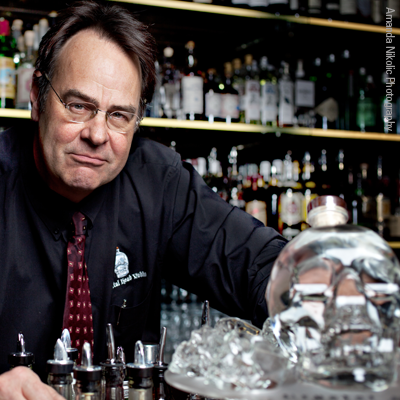
I learned that you're responsible for this skull of liquor in every bar that I've been in in the last two years.
Not enough bars.
And I love this, who doesn't love a skull?
The skull is based on the 13 crystal heads.
13 of them were supposed to have been ascribed to origins in Aboriginal culture.
The Mayans, the Navajo, the Aztec were said to have had these crystal skulls, which were scrying devices.
They were crystal balls.
They looked into to project the future of the tribe and...
One of the Indiana Jones relics was a skull.
Yes, it was the Mitchell Hedges skull.
Excuse me, it has a name.
Yeah, Mitchell Hedges was the explorer whose granddaughter discovered the skull.
Now, the woman of the Smithsonian who has two crystal heads, I believe she has a cloudy white one and a cloudy green one.
She says they're all fakes, but there are some that claim that there really are, have Aboriginal origins and the Navajo and the Aztec and the Mayans said they came from the skull.
They're the star children given to us to give us guidance and in the Spielberg movie of course there was an extraterrestrial origin to them.
What the legend did for us when serving our vodka, it helped us to underwrite our message of purity because many lesser expensive vodkas add the following things.
I don't mention names, but many vodkas on the bar, if you open them up, they smell like Chanel No.
5 and why is that?
Because they add propylene glycol, which you know is a preservative and an antifreeze.
They do that to produce an extra viscosity.
We do not need that extra viscosity.
Propylene glycol, that's like in every thick liquid you buy in a cosmetics shop.
We took that out of our vodka.
The next thing they add is limonene, which is a citrus oil, which is a bug exterminate or a caustic cleanser.
They do that to increase the sweetness.
Well, we don't need that because we have peaches and creamed corn in our mash and that produces a natural sweetness.
And then the other thing they add is sugar.
All we have is H2O and then C2H5O6.
That's it.
That's the formula for crystal head.
That would be water plus alcohol.
Yes, and if you look...
That's the simplest alcohol.
It is simplest alcohol.
Ethanol?
Yes, it's corn.
Yes.
Now, if you look at the molecular equation for glycol, which I just mentioned, and citrus oil, and then sugar, you see a string that just goes way, way out to the end of the page.
And I tell bartenders, why do you want that crap in there?
You're making a Long Island bar car martini.
It doesn't call for citrus oil.
Why not use a zero additive vodka?
And that's what we have.
Crystal head is cleanest vodka on the planet.
It is a wellness product that has won quadruple medals.
Wait, did I just hear you say, we have a wellness vodka?
Yes.
Boy, I could get in trouble for that.
It's in all the yoga spots.
And of course, crystal then is the right word for it.
When the crystal spheres, before we understood gravity, planets were said to be orbiting in crystal spheres.
And the reason why they were crystal is because they knew some were farther away than the others.
And if they were embedded in a sphere, you had to be able to see through that sphere to get to the other spheres.
So it had to be made of something transparent, hence the crystal spheres.
Purity and clarity and transparency.
Now, at the heart of our planet, we know there's the mantle and there's the magma.
Is there a crystal?
No.
There's no crystal.
What's there?
There's an iron sphere.
But it's molten.
It's molten, but it is a perfect iron sphere right there in the center of our planet, right there.
But it's not magic that it's a sphere, because back when earth was entirely molten, if you're heavy, you go to the middle.
If you're light, you float to the top.
And so the heaviest stuff in town is the iron, platinum.
But there's a symmetry, a total symmetry.
But it all goes to the center of this object, and gravity comes from every direction.
So gravity likes spheres.
And if you're above a certain size, where the gravity is stronger than the strength of the rock, gravity will turn you into a sphere.
And that's why all little things in the solar system look like Idaho potatoes.
They're not big enough for their own gravity to turn them into a sphere.
So the core center of our planet, there's just that molten ball.
Yeah, it's a sphere.
And the moltenicity of it is what gives us our magnetic field.
And in the center of that, there's nothing.
It's just a molten.
No, it's more molten.
More molten.
Oh, you want some diamond crystals.
We just walked into the museum today, and we saw the Stribnite down in there.
Oh, yeah, isn't that quite a thing?
You want that to be down to the middle.
How about in Mexico, this crystal cave, where the structures are three to four to five feet across and 50 feet high?
Well, because you need the empty space for the crystals to grow into.
So caves are great repositories of crystals.
The center of the earth is too much weight above to think that we're going to have empty space.
My boy is talking about everything under the sun.
Okay, I just got to say this, and I'll get it off my chest.
I just love the fact that Neil kind of pointed out, when you open up a crystal head vodka, it smells just a tiny bit like BS.
I couldn't help it, I'm sorry.
So you're listening to StarTalk Radio.
We'll be back with my interview with Dan Aykroyd in just a moment.
StarTalk Radio, our last segment, featuring my interview with Dan Aykroyd.
So, Chuck, no, it wasn't BS.
I mean, he's quite proud of what he does not put in his product.
Hey, listen, I'm cool with that, Neil, but-
Dan Aykroyd's vodka, but here's the thing.
You were incredulous, and rightfully so.
Like, are you trying to tell me you have a wellness vodka here?
I was like, absolutely.
He used wellness in the same sentence as vodka.
Okay, that may be a first.
Come on.
Well, have you tried it yet?
No, but-
Well, then there you go.
I haven't tried flying, but I'm pretty sure I can't do it.
Let me point something out also.
Look, you can't have just pure ethanol and pure water, because it doesn't taste like anything.
I called it, what did I call it?
You said that it was the simplest alcohol.
It turns out that-
And I said it was methanol.
No, you did say it was ethanol, which is correct.
No, I said it was ethanol, sorry.
It was correct, but then you said it was the simplest alcohol, which it is not.
The simplest alcoholic molecule is called methanol.
That's the word.
Okay, so I labeled the alcohol correctly.
I just didn't say that it was the simplest one.
So the simplest one is methanol.
Which if you drink, you will go blind, so don't drink it.
But ethanol is the stuff we can tolerate in small amounts because our liver can deal with it before we die.
So Chuck, on the old list of things that will make you go blind?
Methanol?
Methanol's on that list.
Oh, you're not going there, are you?
Oh, come on.
It's way down on that list.
Is that the anatomy of humor you're referring to there, Neil?
I was all implied there.
Well, guess what, that's part of the science of humor.
We all know what makes you go blind, so if you don't mention it, it's funny.
When you do mention it, now it's hacked.
Yeah, so I'm just impressed just the breadth of the stuff I could talk about.
He's deeply curious about the world.
Plus, I mean, he's got a passion for science as well.
Good for him.
And you know what, that makes sense though.
I have yet.
When I first met him, because he's in a special family membership at the American Museum of Natural History.
And the family members, there's a special family night and he comes in with, he came in with this kid.
Every comedian that I meet that's good at doing this, you bring up science and they light up and they wanna start talking to you.
Every comedian I meet, I don't care who they are, what club I'm at, you bring up science and they're like, oh yeah.
And they're almost a little embarrassed about it, but they start talking to you about it.
So it makes sense.
Wonderful.
Well, I asked him just how does he feel about the science we know, the science we don't know.
Just where does he land on that landscape?
And let's find out what he told me.
Dan, in this interview, you've been whipping out chemical terms, geological terms, biological terms, fess up.
Come on, what are you doing in your free time?
Tell me.
Well, I'm listening to you, professor, and always following what you have to say, and always interested in publications like Popular Science and Scientific American.
And you know, my dad was a highway engineer.
And so geology was a big part of his background, and physics, and tangents, and curves, and he could rip through a cosine, no problem.
And tell you what...
I love it, ripping through a cosine.
Yeah, I love that.
My pop built a beautiful highway in Canada called the Gatineau Parkway.
And he laid out this highway and blasted through a granite mountain and has always been interested in the geophysical world.
So, you know, I kind of got a little bit from him.
But I'm always learning and always want to learn.
And I think that the motto of of StarTalk is that science is the new rock and roll.
Oh, do we do we do we do we bronze that or or guild that statement?
Science producers, have we?
Yeah, can we keep that?
Although, you know, science is older than rock and roll.
So maybe rock and roll is the new science.
That just doesn't work, though, Charles.
Nobody nobody's going for that.
You know, Charlotte's web author, EB.
White, said, analyzing humor is like dissecting a frog.
Not a lot of people are interested and the frog dies.
Lost me again.
It's a pretty safe bet to say that EB.
White references are never funny.
Chuck, I'm going to leave the comedy to you.
I'll stick with the science of humor and wonder whether I have any funny in me at all.
Chuck, getting back to your point that the best comedians you've seen, they embrace science, even if they don't necessarily understand it, they understand that it's something to want to know about.
You know what?
Because in order to be a good comedian, you have to be intellectually curious.
I don't care.
As all scientists are.
Right.
That's like part of, like you said to me one time, all children are scientists.
Yeah.
We just beat it out of them.
Spent the first year teaching them to walk and talk, and the rest of their life telling them to shut up and sit down.
Exactly.
So, you know, the fact is in order to be a good stand-up comic, you have to be intellectually curious.
You read everything because what you're looking for is an angle.
You're looking for a reference to look at things differently than others.
You need enough people to know enough science to make any reference to that at all.
Otherwise, it'll fall flat.
Well, see, this is the thing.
Like, when you go out and do humor, okay, talk about reading a room.
When I walk into a room, I have to be able to read that room within five to seven seconds to figure out who am I talking to?
Not eight seconds.
To whom am I talking?
Not eight seconds.
Five to seven.
Psychology.
Right.
This is not seven-minute abs.
This is six-minute abs.
Six-second abs.
And you can't give them a survey in advance.
Right.
You got to feel them.
You got to feel that out.
And if the crowd is a dumb crowd, you got a problem with your hands.
So, EB.
White comments aside, there's actually hope for me.
He didn't say that.
I won't quit my day job, gentlemen.
Listen, you've been listening to StarTalk Radio.
Find us on the web, startalkradio.net, and we tweet StarTalk Radio, of course.
Chuck, you tweet.
Yes, at Chuck Liu.
At Chuck Liu, and Chuck Nice tweets at Chuck Nice Comic.
At Chuck Nice Comic.
And I tweet too.
Do you want to hear my tweet?
Go ahead.
It's Neil Tyson.
StarTalk Radio brought to you in part by a grant from the National Science Foundation.
I'm Neil deGrasse Tyson, signing off, as always, by bidding you to keep looking up.
See the full transcript



 Unlock with Patreon

 Become a Patron